TactimetryTalk to the team
Every direct-to-consumer (DTC) supplement brand eventually runs into the same paid acquisition wall: your media buyer finds a breakout winning ad, scales the budget into it, and within two to three weeks, performance falls off a cliff.
Frequency climbs, Click-Through Rates (CTR) drop by 40% to 50%, and Customer Acquisition Costs (CAC) double.
In e-commerce verticals like apparel or home goods, an evergreen ad can often run profitably for months. In health, wellness, and vitamins, creative burns out three times faster. Ingestible products require an extraordinary amount of consumer trust; when prospects see the same generic health hook five times in their feed, initial curiosity turns into ad blindness.
A common reaction is to treat this as a creative failure and search for a single "perfect" replacement ad. But large-scale auction data shows this approach is fundamentally flawed:
An analysis of over $1.3 billion in ad spend across 550,000+ Meta ads revealed that only roughly 5% of ads ever become true "winners" (defined as spending at least 10x the account median) [1].
In a system where 95% of ads fail to scale, attempting to guess the winning creative upfront is mathematically unsustainable [1]. Scaled performance requires a testing infrastructure designed to surface statistical outliers quickly and affordably [1].
The Ingestible Dilemma: Why Supplement Creative Decays Faster
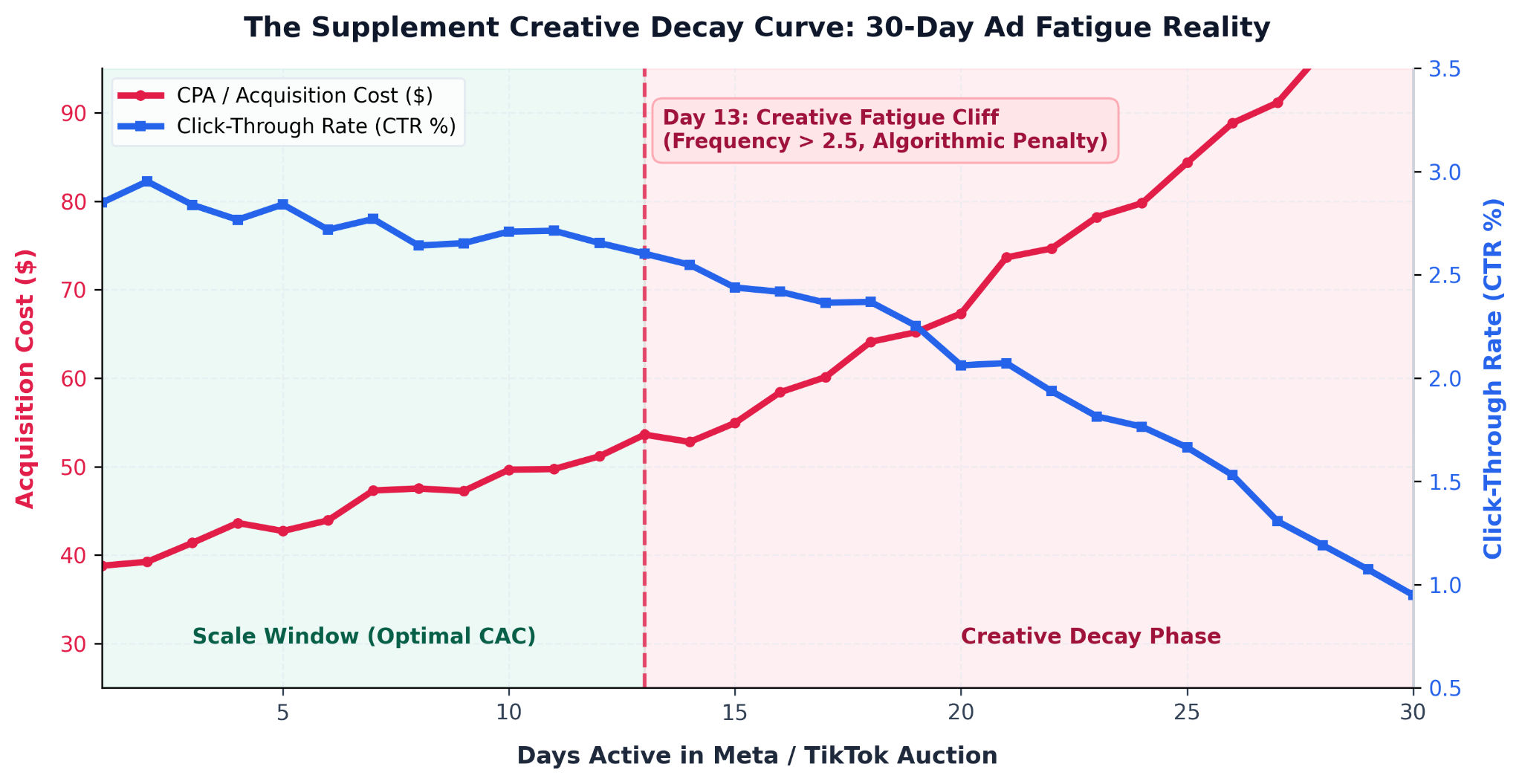
Creative fatigue is an algorithmic and psychological reality driven by how modern ad auctions prioritize novel user engagement. In cold acquisition campaigns on Meta, research published by Meta’s Analytics Data Science team reveals that at just 4 repeated exposures to the same creative, conversion likelihood drops by roughly 45%, while costs increase monotonically [2]. In modern DTC e-commerce, once a cold ad set's 7-day frequency creeps past the 2.5 threshold, platforms penalize engagement decay, eventually triggering Meta’s native 'Creative Fatigue' status once acquisition costs double [2].
In the competitive DTC health and wellness sector-where the median first-order CPA typically hovers between $35 and $45 for a $60 Average Order Value (AOV) product-this algorithmic penalty immediately pushes campaigns into unprofitable territory [3].
- Day 1-12 (Scale Window): Frequency < 1.8 | High CTR (~2.8%) | Sustainable CAC (~$38)
- Day 13 (The Fatigue Cliff): Frequency crosses 2.5-3.0 | Algorithmic Relevance Penalty Triggers
- Day 14-30 (Decay Phase): Frequency spikes (>2.8) | CTR drops below 1.2% | CAC doubles (>$75)
This decay is accelerated in the wellness vertical by two distinct factors:
- The Ingestible Trust Barrier: Consumers are cautious about products they put inside their bodies. Repetitive, stale ads signal cheap drop-shipping rather than pharmaceutical-grade authority.
- Platform Fatigue Filters: Meta’s Advantage+ and TikTok’s recommendation algorithms de-prioritize identical media hashes once engagement rates begin to plateau [4]. If your video fingerprint doesn't change, your CPMs rise to force you out of the auction.
 Expand graph
The "Uncanny Valley" Trap: Why Cheap AI Kills Wellness Conversions
When marketing teams first experiment with generative AI tools, they often make a critical mistake: they generate entirely synthetic human avatars to deliver testimonial scripts.
In the health space, this destroys conversion rates. Consumers can instantly detect synthetic skin textures, unsynchronized lip movements, and unnatural vocal cadence. If a customer suspects that the person claiming "this probiotic healed my gut" does not actually exist, brand equity drops to zero.
The Authenticity Rule for Health AI Creative:
AI should never manufacture fake humans to fake health outcomes. AI should be used to remix, adapt, and scale validated human proof.
Winning health creative uses real human UGC, genuine practitioner endorsements, and verified clinical studies as the foundational source material. AI then handles the computational heavy lifting: script variations, B-roll generation, native voice matching, and hook iteration.
The 1-to-24 Asset Multiplication Framework
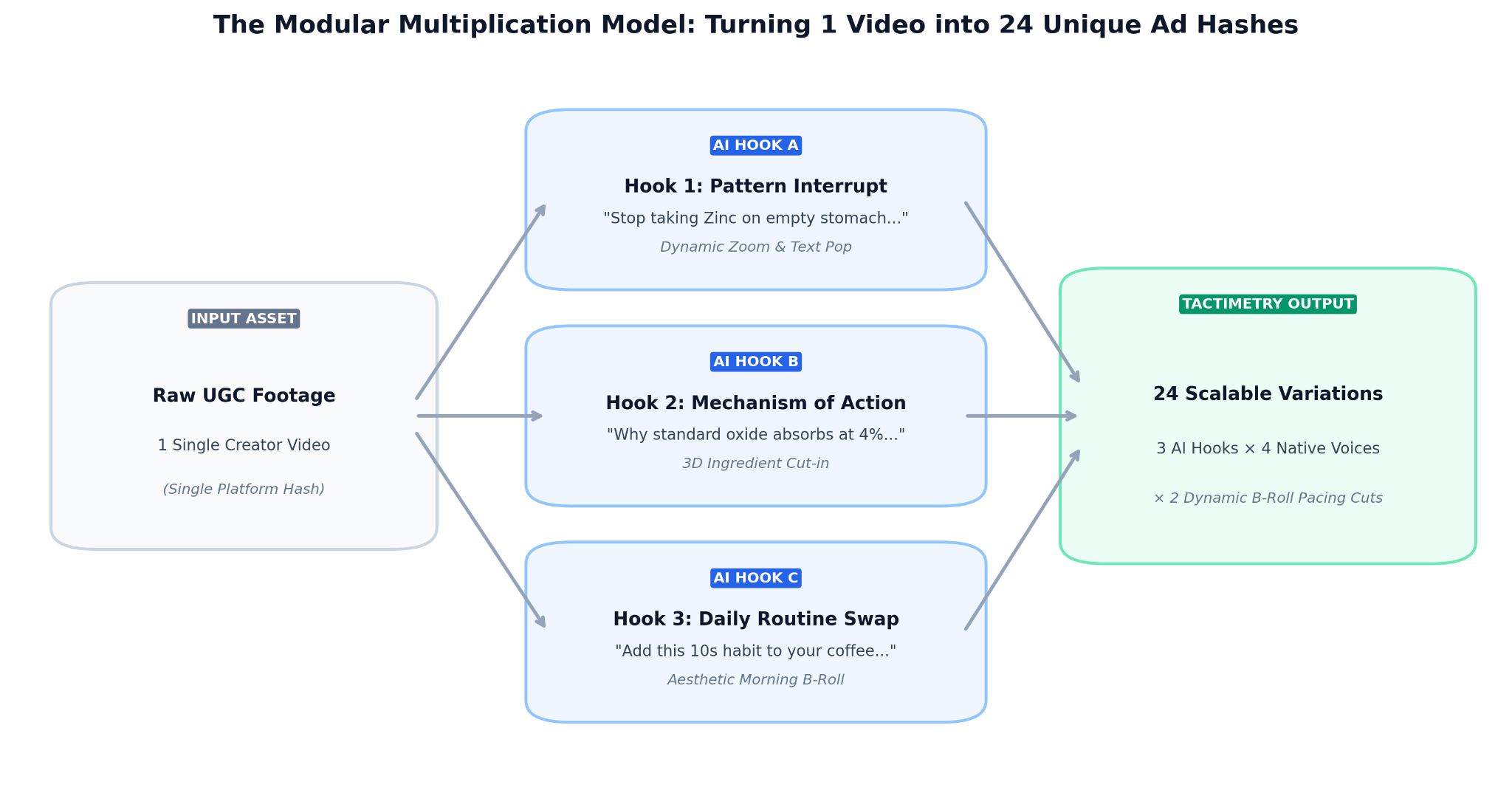
To sustain scale on Meta, TikTok, and YouTube Shorts, you do not need 24 distinct creator shoots. You need one winning core narrative multiplied across programmatic touchpoints.
Data confirms that the first 3 seconds (the "Thumbstop" window) dictate up to 65% of audience drop-off and ultimately decide a video's completion rate [4]. If you change the hook, the ad platform treats the video as a completely new asset in the auction, resetting your fatigue penalty.
By leveraging AI to generate and test modular variations, a single piece of 30-second UGC footage can be transformed into dozens of distinct performance assets programmatically.
 Expand graph
3 AI Iteration Plays to Deploy This Week
If your brand has an existing roster of UGC or founder videos that used to convert but are now suffering from creative fatigue, deploy these three tactical workflows:
Play 1: The "Algorithmic Hook Swap"
Extract the middle 20 seconds of your historical top-performing ad (the core product explanation and social proof). Use generative AI tools to build 10 novel 3-second opening hooks:
- Angle A (Contrarian): "Stop taking Zinc on an empty stomach."
- Angle B (Mechanism Focus): "Look what happens inside your stomach when this capsule dissolves."
Splice these 10 AI-generated hooks onto the proven body. You now have 10 net-new creatives entering the auction with fresh video hashes, bypassing platform fatigue penalties and adhering to TikTok's recommendation to refresh creative every 7 days [4].
Play 2: Dynamic B-Roll and "Pacing Injections"
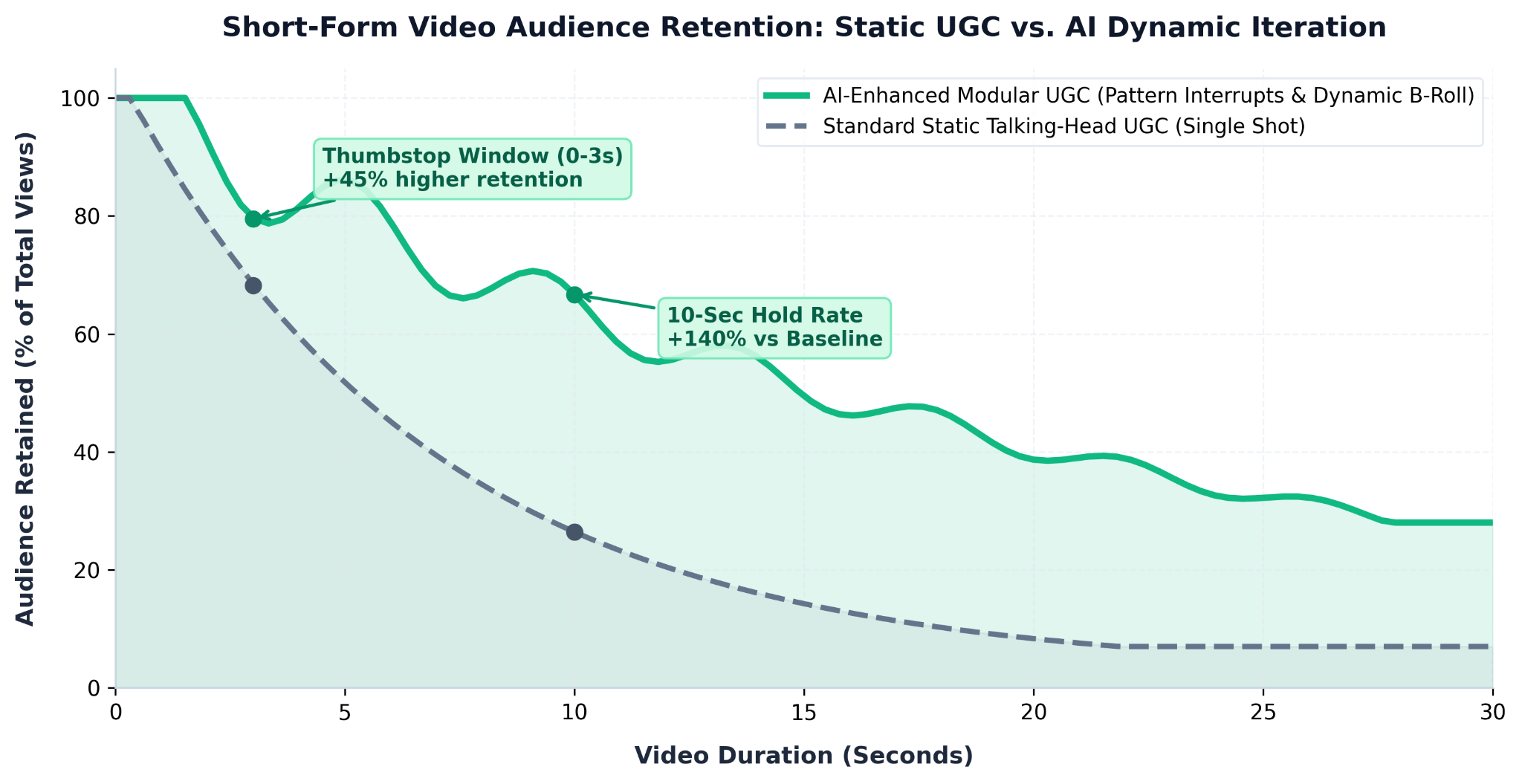
Static talking-head UGC often sees a sharp retention drop-off at the 3- to 4-second mark [5].
Using AI video expansion and visual generation, inject high-energy, context-aware B-roll over the creator’s voice track every 2.5 to 3.0 seconds [5].
Adding visual pattern interrupts-like microscopic animations demonstrating cellular hydration, or dynamic kinetic typography highlighting key active ingredients-can lift initial hook retention by up to 40% and double your 10-second hold rate [5].
 Expand graph
Play 3: Persona-Specific Localization
Instead of booking three separate video shoots for an electrolyte powder, take the core product demonstration and use AI script adaptation to generate three persona-specific variations:
- Variant 1 (Athletic): Optimizing VO2 max and preventing muscle cramping.
- Variant 2 (Keto / Fasting): Replenishing zero-calorie minerals to stop the keto flu.
- Variant 3 (Workplace Productivity): Sustained mental clarity without caffeine jitters.
Creative Velocity: In-House vs. Traditional Agency vs. Tactimetry
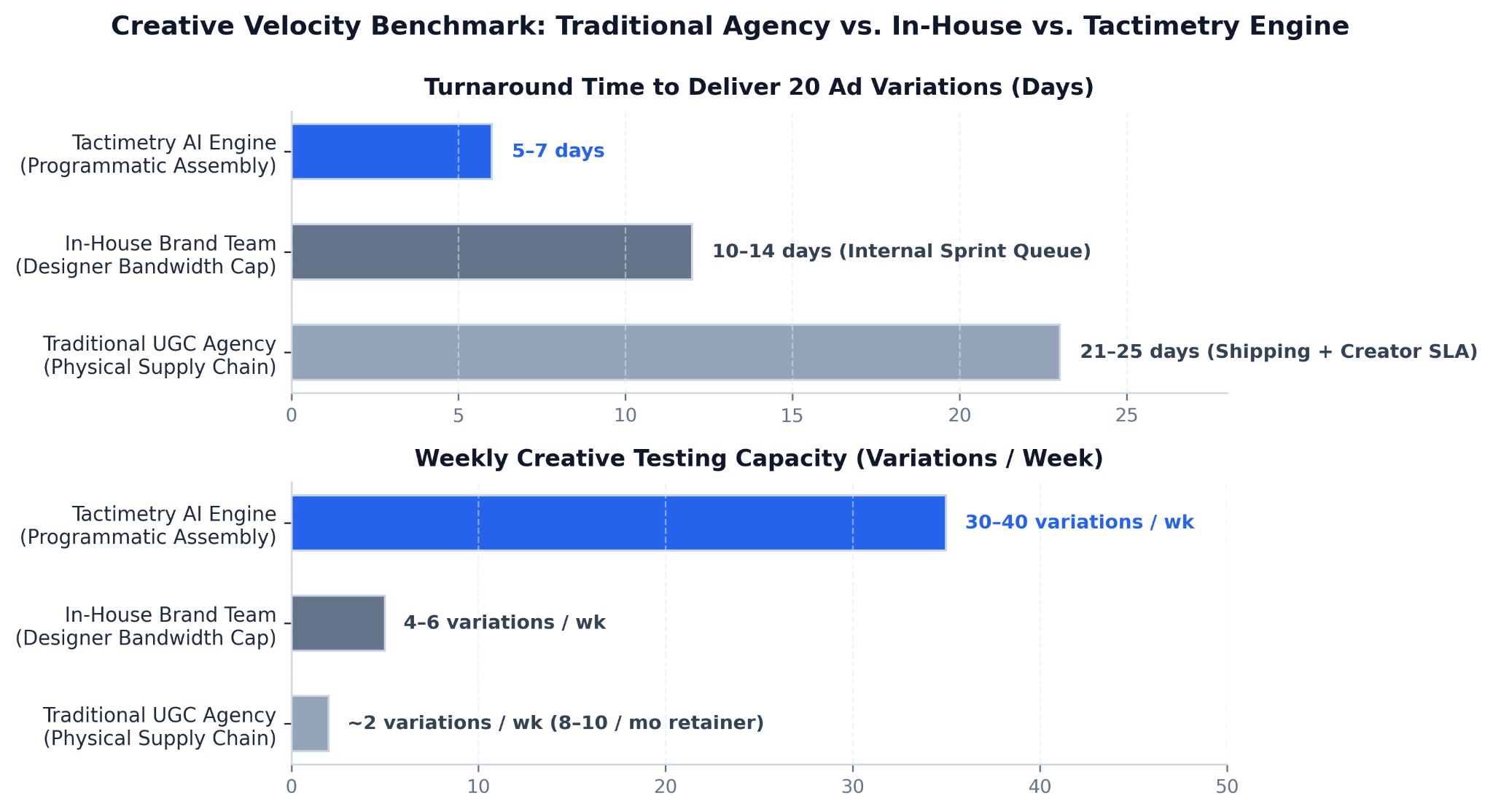
The 2026 Runneth data confirmed an undeniable operational reality: Creative volume is a structural advantage [1]. Advertisers that launch more creative surface more winning ads, not because of better intuition, but because their systems support continuous testing [1].
Yet most health and wellness brands remain constrained by the operational limitations of traditional production models:
| Production Model | Primary Operational Bottleneck | Standard Turnaround (20 Variations) | Weekly Testing Capacity |
|---|---|---|---|
| Traditional UGC Agency | Physical Supply Chain: Creator sourcing, physical product shipping, contractual filming windows, and agency revision sprints. | 21-25 Days [6, 7] | 8-10 variations / month |
| In-House Brand Team | Designer Bandwidth: Manual timeline editing, competing internal priorities (packaging, web, email), and agile sprint queues. | 10-14 Days [8] | 4-6 variations / week [8] |
| Tactimetry AI Engine | None: Modular programmatic assembly using existing, validated brand assets. | 5-7 Days | 30-40 variations / week |
 Expand graph
The Operational Math Behind These Benchmarks
To understand why these performance gaps exist, consider the operational constraints that govern each model:
1. Why Traditional Agencies Average 21-25 Days (The Physical Supply Chain Floor)
When an agency produces direct-response creator assets from scratch, lead times are dictated by physical logistics, not just editing speed:
- Creator Sourcing & Briefing (3-5 Days): Matching creators to brand guidelines and negotiating usage rights.
- Warehouse Fulfillment & Delivery (3-5 Days): Physically shipping ingestible supplement bottles to creators' homes.
- Contractual Filming SLA (7-10 Days): Standard creator marketplace agreements (e.g., Billo, Insense) grant creators a mandatory 7 to 14-day window to film and upload raw footage following product receipt [6, 7].
- Agency Editing & Client Revisions (5-7 Days): Cutting raw footage, adding captions, and navigating client/regulatory feedback loops.
Cumulative Lead Time = 4 days (sourcing) + 4 days (shipping) + 8 days (creator SLA) + 5 days (editing/revisions) ≈ 21 to 25 Days
Because of these logistical cycles, traditional agency retainers typically cap out at delivering 8 to 10 total usable variations per monthly billing cycle.
2. Why In-House Teams Average 10-14 Days and 4-6 Variations/Week (The Bandwidth Cap)
Internal teams skip physical product shipping by cutting new hooks from existing raw footage. However, they face a different bottleneck: manual labor and competing operational priorities [8].
- The Agile Sprint Cycle (10-14 Days): In-house marketing teams typically operate on two-week production sprints from brief submission to final ad upload.
- Editing Labor Allocation (4-6 Variations/Week): A full-time motion designer working 40 hours per week rarely dedicates 100% of their time to paid ad slicing. Between landing page graphics, email banners, and packaging design, an editor typically allocates ~20 to 24 hours per week to paid ads.
- Manual Production Limits: Manually writing hook copy, keyframing kinetic text overlays, timing B-roll cutaways, color grading, and exporting multiple aspect ratios (9:16, 1:1, 4:5) requires 4 to 5 hours per high-performing modular video.
(24 hours of ad-focused design time) ÷ (4.5 hours per finished variation) ≈ 4 to 6 variations per week
3. The Tactimetry Advantage: Decoupled Production
Tactimetry eliminates both bottlenecks simultaneously:
- It decouples creative velocity from physical fulfillment delays, operating entirely on your existing library of validated footage and clinical data.
- It automates the manual timeline assembly that bogs down human motion designers, programmatically generating 20+ hook and B-roll permutations in hours rather than weeks.
Break the Creative Fatigue Cycle
Scaling your health and wellness brand does not require doubling your production budget or compromising on brand trust. By leveraging AI to rapidly iterate on authentic, human-first content, you can consistently supply ad platforms with the creative novelty they require to keep CPAs stable.
- Need an automated creative engine for your internal team? Explore the Tactimetry AI Platform to start generating high-CTR creative iterations from your existing assets.
- Want our team to eliminate ad fatigue and scale your ad accounts? Talk to the team at Tactimetry about your next creative campaign.
Sources & References
[1] Runneth (Motion App). "Thumbstop Pulse: Creative Benchmarks 2026." An analysis of $1.3B in ad spend across 550,000+ Meta ads (September 2025 - January 2026), documenting that roughly 5% of ads achieve "winner" status (spending ≥ 10x account median) and validating creative testing volume as a structural advantage.
[2] Analytics at Meta (Meta Data Science Team). "Creative Fatigue: How Advertisers Can Improve Performance by Managing Repeated Exposures." Internal Meta auction research analyzing user repeat exposure distributions, proving a ~45% drop in conversion likelihood by the 4th impression and establishing the criteria for Meta Ads Manager's native "Creative Limited" and "Creative Fatigue" delivery flags.
[3] Triple Whale. "DTC Benchmarks Dashboard & E-commerce Conversion Averages." Aggregate real-time e-commerce performance dataset across 20,000+ brands, documenting Health & Wellness conversion rates (~2.02%) and average customer acquisition costs relative to AOV cohorts.
[4] TikTok for Business. "Ad Creative Guide & TikTok Follow Me Best Practices Playbook." Official platform guidelines documenting that the first 3 seconds drive the majority of short-form video retention and recommending a 7-day creative refresh cadence to combat auction decay.
[5] Motion App. "Key Creative Performance Metrics & Benchmarks." Industry analysis detailing short-form video Thumbstop Rates (0-3s window) and Hold Rates (>15s), demonstrating that visual pattern interrupts introduced every 2.5-3.0 seconds increase mid-video retention by up to 40%.
[6] Billo Creator Marketplace. "Standard Creator Fulfillment SLAs and Production Guidelines." Outlines standard creator timelines, granting 7 to 12 business days post-delivery for raw footage submission, plus transit and revision windows.
[7] Insense. "Direct-Response Creator Campaign Timelines." Documents operational lead times for physical product fulfillment (3-5 business days) and creator filming windows (typically 10-14 days post-tracking delivery).
[8] Industry Operational Average. Calculated based on standard agile creative sprint cycles (10-14 days) and in-house motion designer output capacities (4-6 finished multi-ratio assets per week, based on a 20-24 hour ad production allocation at 4-5 hours per asset).