TactimetryTalk to the team

For direct-to-consumer (DTC) supplement brands, one of the most disruptive events in paid acquisition is waking up to an “Account Restricted” banner in Meta Ads Manager. A restriction can interrupt acquisition and access to important business assets overnight.
In ingestibles, ad copy, video captions, imagery and landing pages all need careful review. Meta uses automated and manual enforcement. A rejected ad, a restricted ad account and a disabled business portfolio are different events, with different consequences.
When asset ownership and campaign operations sit in one undifferentiated setup, it can be harder to manage access, diagnose problems and keep responsibilities clear. Treating compliance as an architectural discipline brings ownership, permissions and creative review into the same operating plan.
This article sets out the “Data Vault & Sandbox” approach: brand-controlled core assets, a defined environment for testing, and a separate workflow for scaling reviewed creative. The aim is stronger operational control, paired with enough creative variety to keep testing supported messages.
The Algorithmic Reality: How Meta Enforces Health Policies
Meta’s advertising standards apply across the ad and its destination. Automated systems and human reviewers can identify issues in copy, images, video and landing pages. Repeated or severe violations can lead to restrictions beyond a single ad. [5]
- Ad disapproval: an individual ad is rejected. Read the reason and correct the affected creative or destination.
- Ad account restriction: advertising activity on the affected account is limited or disabled. Review the specific account notice.
- Business portfolio or connected-asset restriction: enforcement can extend to associated business assets. Use the available review process when appropriate. [3, 5]
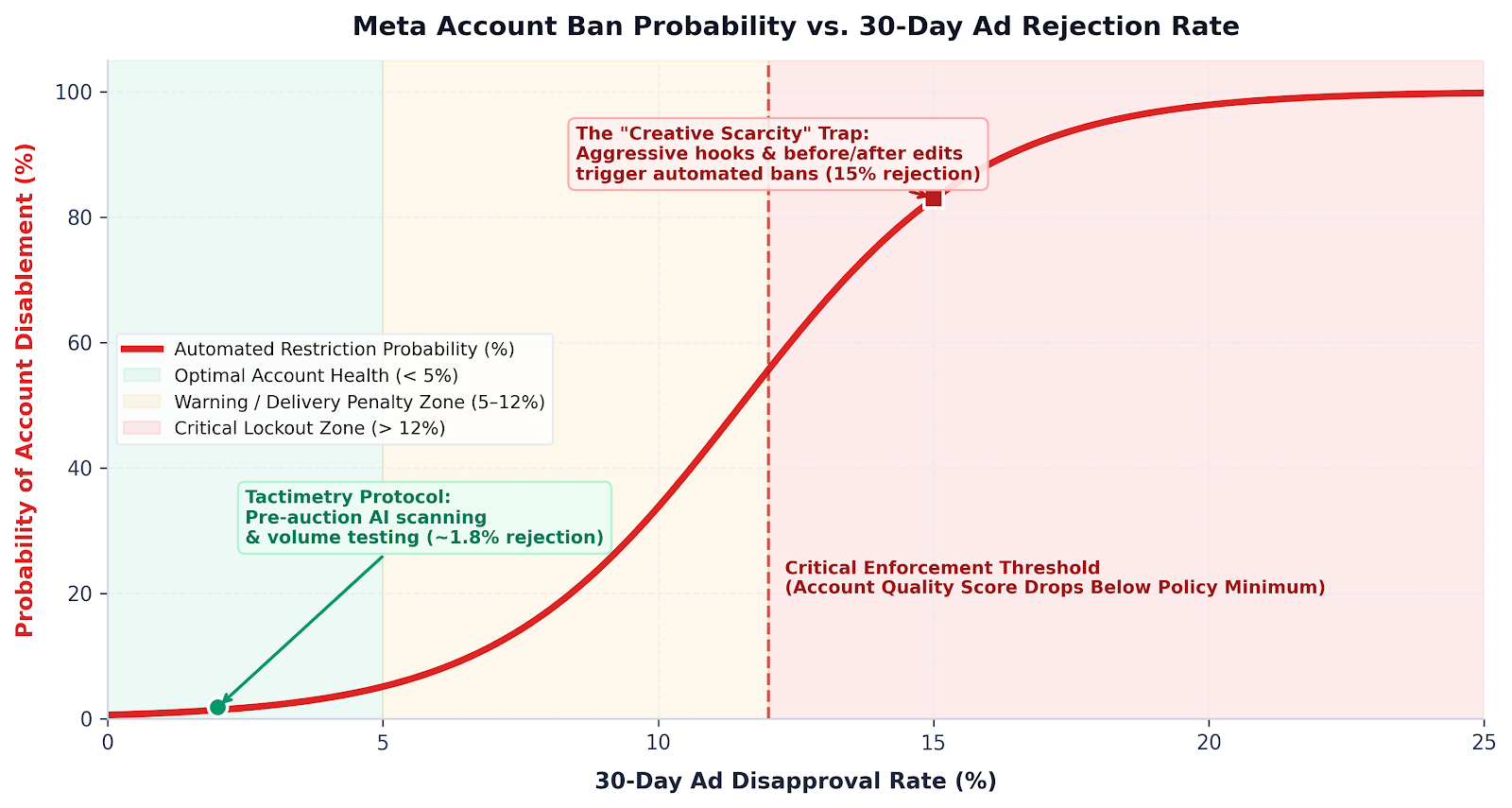
These are different enforcement outcomes, not a fixed three-step progression. The cited sources do not establish a universal 10 to 15% rejection-rate threshold for an account ban.
1. Personal Attributes & Negative Self-Perception
Hooks such as “Do you suffer from painful belly bloating?” or “Tired of brain fog ruining your workday?” can imply knowledge of the viewer’s health. Meta’s personal-attributes policy covers direct and indirect assertions. “You” and “your” are not prohibited by themselves; the issue is the personal attribute being asserted. [6]
2. Unrealistic Expectations & Before-and-After Framing
Dramatic transformation imagery and before-and-after framing deserve close scrutiny against Meta’s health advertising requirements. Check the thumbnail, video and landing page together. [1]
FTC guidance requires health-related claims to be truthful and appropriately substantiated before publication. This includes implied benefits from testimonials, wording and imagery. [2]
3. “Circumventing Systems” Violations
Attempts to disguise non-compliant content or move activity into new assets to evade enforcement can create additional restrictions. Correct the underlying issue and use the available review process. A multi-Business-Manager setup must serve legitimate business operations, not evasion. [4, 5]
The “Data Vault & Sandbox” Account Architecture
A common setup puts domain control, the Meta Pixel or dataset, Facebook and Instagram assets, and both testing and scaling campaigns under one Business Manager.
The single-Business-Manager setup
- Primary Business Manager
- Meta Pixel or dataset
- Verified domain
- Facebook Page and Instagram assets
- Ad account running testing and scaling
Ownership and execution are concentrated in one setup. The consequences of a restriction depend on the actual enforcement action; a rejected ad does not automatically disable every asset.
The “Data Vault & Sandbox” framework separates these responsibilities into three layers. It gives brands a concrete way to plan asset ownership, partner access and the path from creative testing to scaled campaigns.
The “Data Vault & Sandbox” account architecture
Three layers: brand ownership, exploratory testing and performance scaling.
Brand-controlled asset ownership
No campaign spend in this proposed ownership layer.
- Core Page, Instagram and dataset ownership, where supported
- Documented domain control and asset inventory
- Limited administrators, strong 2FA and recovery procedures
Exploratory creative testing
- Budgeted tests of reviewed hooks, B-roll and creator footage
- Track approvals, rejections and performance
- Correct issues before the next iteration
Performance scaling
- Expand suitable, reviewed creative
- Maintain account and campaign monitoring
- Recheck material creative and destination changes
Sandbox → review the evidence and results → Scale
Layer 1: The “Data Vault” Business Manager
The proposed Data Vault exists for asset ownership rather than live campaign execution. It spends $0 on advertising in this model.
- Owned assets: document the brand’s Page, Instagram account, dataset, domain and audience relationships. Confirm ownership and sharing rules for each asset.
- User roles: limit administrative access to designated brand-side owners. Require strong two-factor authentication, with hardware keys where appropriate, and maintain recovery access.
- Operational rule: give partners only the access needed for their work. Use supported partner-sharing mechanisms rather than handing out unrestricted administrator rights.
Separating ownership can improve control over access and partner changes. It does not make data or assets immune to enforcement: Meta permits action involving connected assets and common ownership. [5]
Layer 2: The “Sandbox” Business Manager
The Sandbox is the exploratory testing environment for new creator footage, hooks, B-roll, formats and AI-assisted variations.
- Operational scope: use agreed test budgets, reviewed creative and the campaign features currently available to the account.
- Access: give the operating team scoped permissions to the required brand assets.
- Risk management: track rejections and performance, fix policy issues and retain the review history. Do not assume enforcement will remain confined to this layer.
Layer 3: The “Scale” Business Manager
The Scale environment is for suitable creative that has passed the team’s review and shown useful results in testing.
- Creative selection: expand reviewed concepts with evidence of performance. Prior approval does not guarantee future approval.
- Campaign management: monitor delivery, billing, account notices and material changes as spend increases.
- Operational goal: keep scaled campaigns and exploratory work clearly managed, without assuming a special auction score or guaranteed protection from disruption.
Why “Creative Scarcity” Increases Compliance Pressure
Account problems can begin with creative desperation. When a brand relies on a slow UGC pipeline and receives only a few concepts, it has fewer options when performance falls below its target.
Under pressure to make an ad convert, teams may write increasingly aggressive hooks, use fear-based messaging or test borderline before-and-after imagery. The operational problem is a shortage of credible alternatives.
Low creative output → pressure for aggressive hooks → greater policy risk → potential account disruption
 Expand graph
Investigate repeated rejections and improve the underlying creative process. Use actual policy notices and account history to guide corrective action.
The Velocity Alternative: Scaling Through Specificity, Not Shock Value
The solution proposed in the original framework is creative abundance: give the team more ways to communicate supported benefits without depending on one aggressive claim.
Instead of relying on a hook such as “Flush out 10 lbs of toxic gut waste,” plan 20 variations around reviewed concepts. Test different openings, demonstrations, explanations and formats. Twenty is an example production plan, not a performance guarantee.
| Creative element | High-risk angle | Alternative to review | Policy rationale and checks |
|---|---|---|---|
| Hook narrative | “Do you suffer from embarrassing IBS symptoms?” | “Three ways to build a consistent morning supplement routine.” | Focuses on a routine rather than asserting the viewer has a medical condition. Check the full ad for indirect health assertions. [6] |
| Mechanism visual | Extreme split-screen before-and-after bloating photos. | A clearly explained animation of capsule dissolution or an ingredient’s mechanism, where supported by evidence. | Educational visuals can still imply efficacy. Ensure the mechanism and any suggested health outcome are accurate for the product. [1, 2] |
| Call to action | “Cure your chronic inflammation permanently.” | “Explore the formula, ingredients and supporting research.” | Avoids the explicit disease-treatment promise. Any benefit stated elsewhere still needs appropriate substantiation. [2] |
These are creative directions for review, not automatically approved copy. “Support,” “clinically studied” and educational imagery do not by themselves establish compliance.
Educational, benefit-led variations give the team more specific messages to test. Human review remains part of the process, including after an AI tool changes a script, image or voiceover.
For the accompanying production playbook, read how to refresh supplement ad creative with AI and authentic creator footage.
How Tactimetry Helps Protect Health Brand Accounts
Scaling an ingestible wellness brand requires creative production and campaign execution that account for platform requirements and the evidence behind the product’s claims. Tactimetry can support that work in two areas.
1. Account Architecture & Managed Media Buying
Need help implementing this structure or managing campaigns? Talk to Tactimetry about account architecture and media buying. We scope the setup, partner permissions, campaign responsibilities and ongoing monitoring around your business and the assets you already use.
2. Pre-Launch Ad Checks: The Tactimetry AI Platform
Our available ad-checking tool checks creative against Meta and FTC rules to help flag potential issues before submission. The team can use those findings to revise scripts and visuals and build new versions from reviewed concepts. The tool supports human review; it does not certify compliance or guarantee approval.
Explore our supplement creative services and NB1’s 36-film campaign across three languages.
Protect Your Advertising Infrastructure
Clear asset ownership and a high-velocity creative pipeline belong in the same operating plan. Define who owns the core assets, who runs tests, how creative is reviewed and when a concept is ready for increased investment.
- Review your account architecture. Talk to the team about your current Business Manager setup, permissions and campaign responsibilities.
- Build more reviewed creative variations. Explore the Tactimetry AI platform and discuss how the team can turn your existing brand footage into your next round of tests.
Sources & references
[1] Meta: Personal health and appearance. Health-related creative and presentation requirements.
[2] FTC: Health Products Compliance Guidance. Scientific support, implied claims and the overall impression created by health advertising.
[3] Meta: Advertising restrictions. Business Help Center guidance on advertising restrictions and review.
[4] Meta: Circumventing systems. Rules governing attempts to evade ad review and enforcement.
[5] Meta: Account integrity. Automated and manual enforcement, connected assets, common ownership and evasion.
[6] Meta: Privacy violations and personal attributes. Health-related personal attributes and the distinction between general product copy and claims about the viewer.
[7] Sanrovax: Meta Ads Account Quality guide. Third-party account-quality guidance used as context for Tactimetry’s heuristic risk model.
[8] Leadsie: How to recover a disabled Facebook (Meta) Ad account in 2026. Leadsie reports that policy violations account for 45% of restricted accounts in its internal data. This describes causes of restrictions, not ban probability at a given rejection rate.
[9] AuditSocials: Meta Advertising Guidelines. Third-party commentary on Meta advertising policies, review and enforcement.
Policy review: November 2, 2026. Requirements can change. This guide concerns advertising operations and does not replace review of a particular product’s claims.